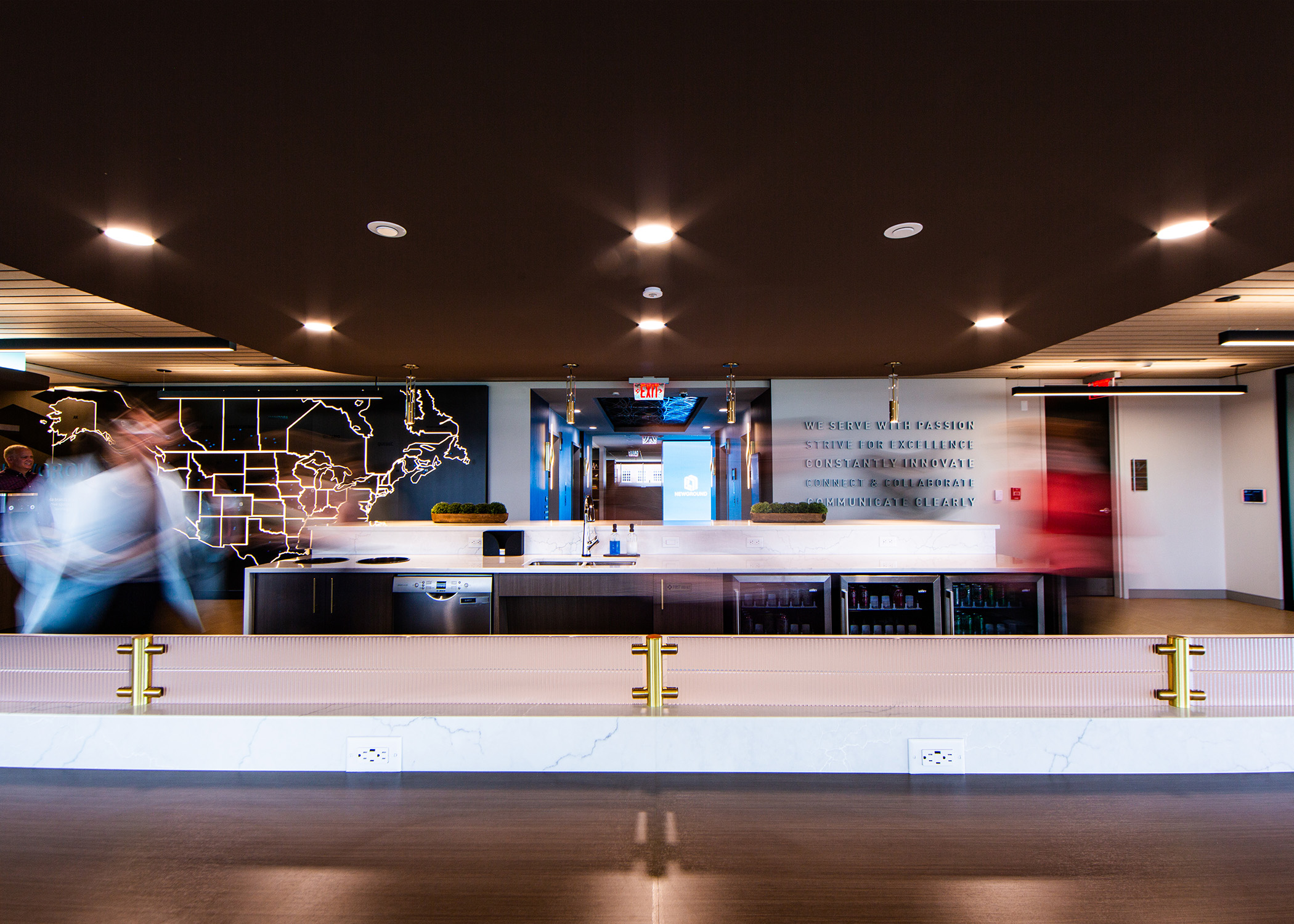
The ROI of Good Design
For decades, a head-turning workplace was measured by square footage and fancy furniture. In 2026, the conversation is fundamentally different.
Organizations have began asking the harder questions.
How do we attract top talent?
How do we create a culture employees want to be a part of?
How do we facilitate collaboration in a hybrid world?
How do we justify one of the largest investments our organization will ever make?
The answer is no longer found in simply updating an office, but found in designing a workplace that excites, inspires, and facilitates dynamic-collaboration.
At NewGround, we’ve spent more than a century helping organizations navigate these questions. While every client is different, one thing has become increasingly clear: thoughtful workplace design is becoming a cornerstone for retention and employee satisfaction.
The Office Has a New Job
Before 2020, the office was just a place where work happened.
Today, work happens almost anywhere. Remote and hybrid models allow employees to choose environments where they are most productive.
Many organizations now operate with some form of hybrid workforce, and despite predictions that employees would fully return to the office, the workplace continues down a hybrid pathway. In fact, a 2024 KPMG survey found that 80% of CEOs expected employees to return to the office full time within three years. Yet, hybrid work remains the dominant model for many organizations.
That fact alone has changed the role of the workplace.
Employees no longer come to the office because they have to. They come because there is value in being there.
As Brad Ritner, Director of Retail at NewGround, puts it:
“Heads-down work has shifted to the home, employees are coming into the office for meaningful interaction.”
The office is no longer simply a place to complete tasks. It has become a destination for connection and belonging.
During a recent planning session, one of NewGround’s clients put it simply: “We have to earn the commute.”
It may be the easiest way to describe the challenge organizations are facing today.
Design That Draws People In
The competition for talent has never been greater.
According to LinkedIn workforce data, only about 20% of job postings are remote or hybrid positions, yet they receive roughly 60% of all applications.
All of the elements that make a job worth having still matter.
Compensation still matters.
Benefits still matter.
Culture still matters.
But the headquarters has become another differentiator.
Ritner often tells clients that a building should become a billboard for your culture. An iteration of your brand and values.
“You want people to drive by your building and think, ‘I would love to work there.'”
A first impression extends beyond recruitment.
Employees want to feel proud of where they work.
They should feel connected to the organization the moment they walk inside.
Good design only reinforces strong workplace culture.
Great Culture Doesn’t Happen by Accident
One of the biggest concerns leaders share today isn’t productivity.
It’s culture.
Maintaining strong relationships becomes significantly harder when employees are dispersed across homes, cities, and even states. Yet those relationships remain essential to organizational success.
Research suggests that workplace relationships play an important role in employee well-being, collaboration, retention, and engagement.
Brad refers to these as “workplace friendships.”
Researchers call these “weak ties.”
They’re the colleague you grab coffee with, the teammate you confide in, the person you check in on, or someone you trust enough to share your concerns with.
Relationships like these are difficult to build through a video call from your kitchen table.
That’s why today’s workplaces increasingly prioritize collaboration space, cafés, outdoor work areas, and flexible work stations.
They’re not just amenities designed to impress, but investments in human connection..
The ROI of Connection
Remote work has created undeniable flexibility.
But that flexibility comes at a cost.
Research from Cigna found that 70% of employees reported feeling disconnected from their workplace, while roughly half of remote employees experience loneliness at least once each week. Other studies have linked workplace isolation to increased burnout and higher healthcare costs.
Those aren’t simply human resource concerns.
They’re business concerns.
Every missed collaboration.
Every disengaged employee.
They all carry financial consequences.
Thoughtful workplace design cannot solve those challenges on its own.
But it can create environments where meaningful interactions happen naturally.
Sometimes the most valuable conversation of the day isn’t sent as a calendar invite.
It’s the one that happens walking to get coffee.
Designing for the Next Workforce
Many organizations unintentionally design around the preferences of today’s leadership rather than tomorrow’s workforce.
Gen Z is expected to make up an increasingly significant percentage of the workforce over the next decade, bringing different expectations around flexibility and workplace experience.
They expect employers whose values align with their own.
They seek flexibility.
They prioritize connection.
They want environments that support both productivity and well-being.
Working With What You Have
When people hear “investment in design,” they often assume it means higher costs.
The opposite is often true.
Good design is about building smarter spaces.
Your headquarters doesn’t need to be bigger, it needs to be purposeful. Efficient layouts can eliminate unnecessary square footage.
Thoughtful departmental adjacencies foster collaboration and drive efficiency.
Natural light improves employee experience without increasing operating costs.
As construction costs continue to rise, every square foot matters. Every square foot needs to be intentional.
The Rise of the Experience Workplace
Today’s headquarters look very different than they did twenty years ago.
Private offices are moving inboard and giving way to shared spaces that leverage natural light.
Meditation rooms, wellness spaces, and hospitality cafés have become common design integrations.
These aren’t luxury features.
They’re responses to changing employee expectations.
High-performing organizations recognize that supporting employee well-being isn’t separate from business performance.
Good Design Is Good Business
The most successful workplace projects don’t begin with selecting furniture or finishes.
They begin with asking better questions.
How will people work here?
How will departments collaborate?
How will culture thrive here?
How will this building support the next generation of employees?
These questions shape organizations long after construction is complete.
Good design is measured by stronger teams and greater productivity.
The real return on investment? Workplaces that continue delivering value long after the ribbon is cut.