The Human Side of Design with Spencer Branham, Director of Branded Environments, NewGround Chicago
In a world where AI can generate images within seconds and automate creative tasks, one question continues to rise to the surface:
What makes design truly human?
For Spencer Branham, Director of Branded Environments at NewGround’s Chicago office, the answer is simple.
“Design is inherently human. You can’t separate the two.”
This philosophy guides every project he and his team touch, from corporate headquarters to communal spaces. While technology continues to reshape how design is created, Spencer believes the most meaningful environments still begin with the same thing they’ve always required: a deep understanding of people.
“If you don’t start with the user, you’re already off to a bad start,” he says. “Every solution we create is designed for a person. If something doesn’t feel right, it’s usually because humanity has been lost somewhere in the process.”
Beyond Branding
Authenticity has become one of the most overused words in design.
True authentic design starts with research, conversations, observation, and a lot of listening.
“My team isn’t picking things off a shelf,” he says. “I often compare it to designing a chair. You don’t know how to design the chair until you know who’s going to sit in it.”
Understanding a brand means going beyond logos and color palettes.
It means studying how organizations interact with their communities.
Only then can design become a genuine reflection of brand identity instead of a surface-level application of graphics.
Designing for First Impressions
Long before someone reads a mission statement or visits a website, they’ve already formed an opinion.
“We’re (multisensory design) often among the very first things people experience,” Spencer says.
The moment someone enters a space, they’re processing information through every sense available to them.
The graphics.
The materials.
The scents.
The sounds.
The atmosphere.
And of course, the people.
“It’s all hitting you the second you walk through the door,” he continues.
That’s why environmental graphics carry such responsibility. The environment becomes the story, it’s where brand becomes experience.
Empathetic Design
Environmental graphic design is often misunderstood as decoration. Some see it as a collection of logos, wall graphics, and branded moments layered into a space.
But Spencer sees it differently.
The most successful environments not only communicate information but create emotional connection.
Research supports that idea. Nearly three-quarters of consumers say their connection to a brand comes from feeling understood and sharing common values. When people walk into a space, they’re looking for experiences that feel meaningful.
“Anyone can create wall graphics,” Spencer explains. “The real opportunity is telling a story that people can connect with.” Often, environmental graphics are the way brand storytelling really comes to life.
That connection happens through moments that reinforce a brand’s identity, history, and belonging. It’s why a decades-old local diner can become a community landmark. People return not simply because of what’s on the menu, but because of what the place represents for them. It feels familiar and authentic. There are memories embedded in the space. It feels human.
The same principle applies inside corporate environments.
When employees and visitors walk through a space, they’re asking unconscious questions like:
Do I belong here?
Do I see myself in this space?
Can I do my best work here?
The answer isn’t delivered through words alone but communicated through design.
Human-Centered Design
Spencer and his team often evaluate spaces through three essential lenses:
Certainty
People want to feel confident in their environment.
“Feeling lost isn’t just a logistical problem, but also an emotional one,” Spencer says.
Wayfinding, visual consistency, and intuitive design all contribute to a sense of certainty. When people understand where they are and how to navigate a space, they feel more comfortable engaging with it.
Variety
While consistency builds confidence, predictability can become forgettable.
Variety creates discovery.
A thoughtfully designed environment introduces different visual moments, textures, stories, and experiences that keep people engaged without overwhelming them. NewGround clients often have integrated variety amongst locations to create diversity and excitement for customers.
“It’s about creating consistency without creating a cookie-cutter experience,” Spencer says.
Delight
Delight is the most difficult marker and often the most memorable. It often occurs when people encounter something unexpected.
Maybe it’s an innovative material application or a graphic treatment they’ve never seen before. Maybe it’s a story that catches them off guard.
Whatever form it takes, delight transforms a functional space into a meaningful experience.
And statistically, experiences are what people remember most.
Storytelling That Builds Culture
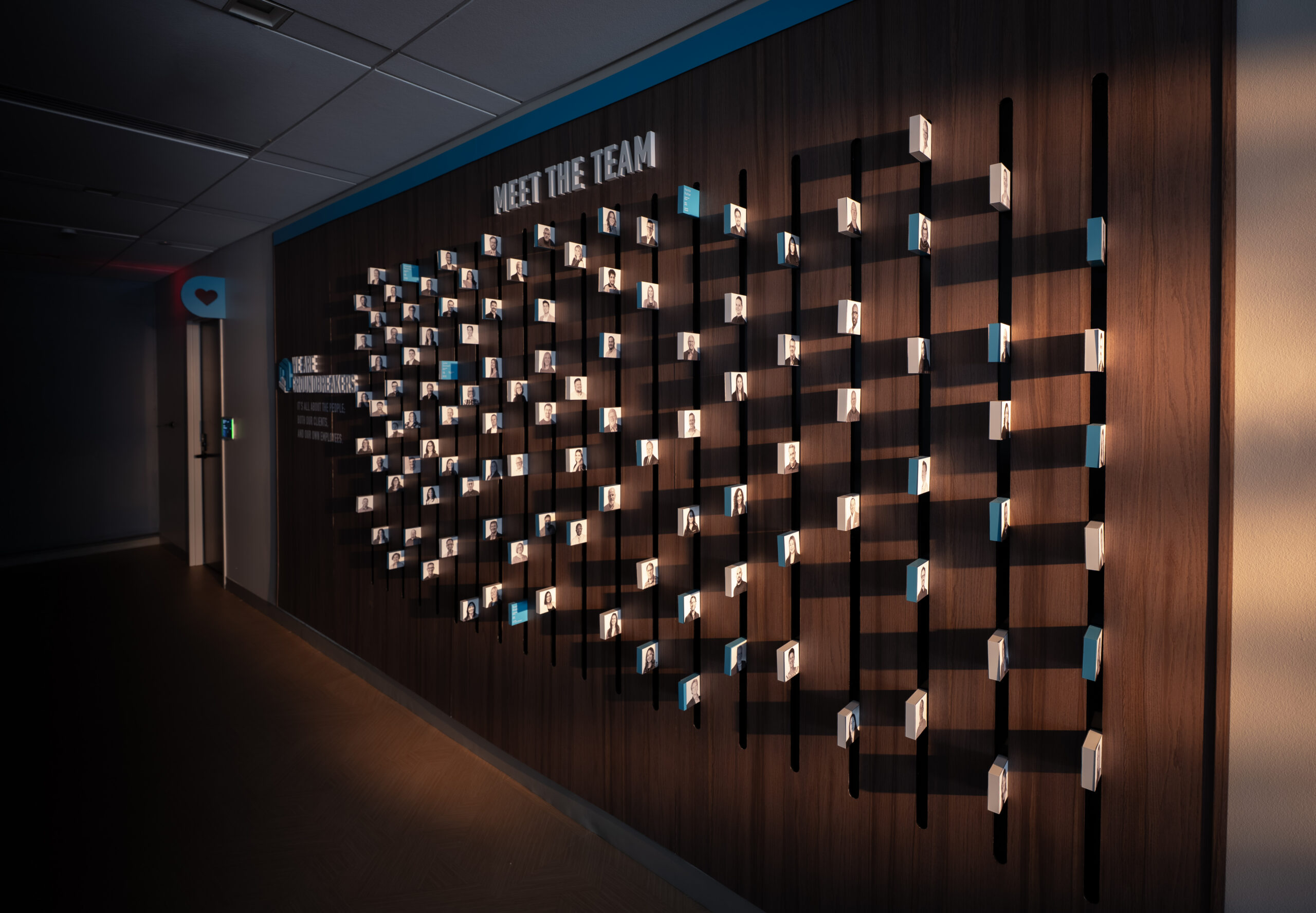
Some of Spencer’s most memorable projects aren’t memorable because they’re visually complex but because they’re personal.
A history wall that celebrates a company’s journey.
An installation that honors long-tenured employees.
A graphic that captures shared values and collective achievements.
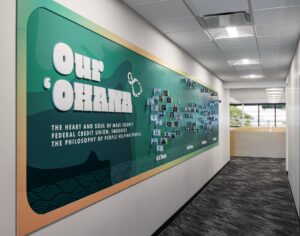
One example he points to is an employee wall at Maui Federal Credit Union located in Wailuku, where varying shades of ocean depth correspond with employment length. This was a very impactful piece for their local and corporate culture as well as employee satisfaction.
These moments may seem small, but they create something powerful.
How Hospitality Gets It Right
When Spencer looks for inspiration, he often turns to industries that have mastered experience design: hotels, restaurants, and resorts.
“They understand that the brand is the experience.”
Hospitality brands don’t view design as a layer applied after strategy, but as a core strategy from the very beginning.
Restaurants know exactly who they’re serving.
Luxury resorts understand how every detail contributes to perception.
“They’re being intentional,” Spencer says. “Sometimes corporate environments don’t go out of their way enough to create those moments.”
The lesson for workplaces is clear: design should be experienced, not just seen. One of the greatest mistakes organizations make is designing for leadership alone. Too often, spaces are shaped by executive preferences instead of the people who use them every day.
“You lose sight of the people walking in it daily,” Spencer says.
The result can feel disconnected. It may be beautiful on paper, but ineffective in practice.
The Human Side of Design
Spencer explains branding through this simple anatomical metaphor.
The brand essence is the heart.
The name becomes identity.
The visual and verbal systems become appearance and personality.
And the rollout?
That’s teaching the person how to walk.
“You’re creating a person just as much as you’re creating a brand, something steeped in history with connections, feelings and values” Spencer explains.
When every piece works together, a brand becomes something people recognize, trust, and relate to.
Not because of the colors or logos.
Because it feels human.
Looking toward the future…
As AI continues to transform creative industries, many conversations focus on what technology can do.
And while it’s important to leverage emerging technologies, Spencer is more interested in what technology can’t do. It can’t replace empathy. It can’t understand lived experiences. And it can’t fully capture the emotional nuances that make people feel connected to a place.
The future of design won’t belong to those who simply create faster but to the people who understand others better.
No matter how advanced technology becomes, one truth remains unchanged:
People connect with stories.
And that’s the human side of design.
About NewGround
NewGround is a strategy, design, build and interiors firm and serves as the industry leader in financial design. With over 100 years of industry knowledge and experience, NewGround helps bring brands to life through physical spaces. Our fully in-house team guides and manages each project from start to finish from dream to done. Headquartered in St. Louis, MO with offices in Waterloo, ON and Chicago, IL.